

Business Golf Etiquette: 2026 Guide to On-Course Success

Updated: Sep 19
Your handicap matters far less than your pace of play when a S$100,000 contract is on the line. While many professionals spend hours perfecting their swing, the real deal-breaker in executive circles isn't a missed putt; it's a lack of awareness that disrupts the flow of the game. Mastering golf etiquette for business meetings is the ultimate differentiator in Singapore’s competitive corporate environment, acting as an 18-hole litmus test for your character, patience, and integrity. You likely understand that the fairway is where genuine rapport is built, yet the fear of slowing down a flight or appearing unpolished can be a significant mental hurdle.
We've designed this guide to help you replace that uncertainty with the quiet confidence of a seasoned player who knows exactly when to talk shop and when to focus on the pin. You’ll learn how to project a composed professional image that transcends your score, ensuring every round strengthens your stakeholder relationships. From understanding local club protocols to the nuances of "ready golf," we're providing a comprehensive roadmap to navigating the green with grace and strategic purpose. By the end of this guide, you'll possess the tools to transform any round into a masterclass in relationship building.
Table of Contents
The Strategic Value of the 'Office on the Green'
In the high-stakes corporate landscape of 2026, the most significant deals aren't always finalized in glass-walled boardrooms. They're often solidified on the fairway. While digital connections provide speed, they lack the depth required for high-level networking. A 30-minute coffee meeting is a curated performance; an 18-hole round is an authentic revelation. Over a four-hour window, the professional mask often slips, allowing you to observe a partner’s patience, integrity, and resilience. Mastering golf etiquette for business meetings is about more than just following tradition. It's the art of being an exceptional companion while maintaining the highest professional standards.
The fairway serves as a unique laboratory for human behavior. When you watch a potential partner shank a ball into the water, their immediate reaction provides a glimpse into their business temperament. Do they maintain their composure, or does their frustration boil over? This "character litmus test" is why golf remains the premier environment for building trust. It allows stakeholders to evaluate how you handle setbacks before they commit to a multi-year contract. To stay sharp on the latest market trends that influence these contracts, you can visit Phil Stock World.
Why Etiquette Trumps Skill in Business
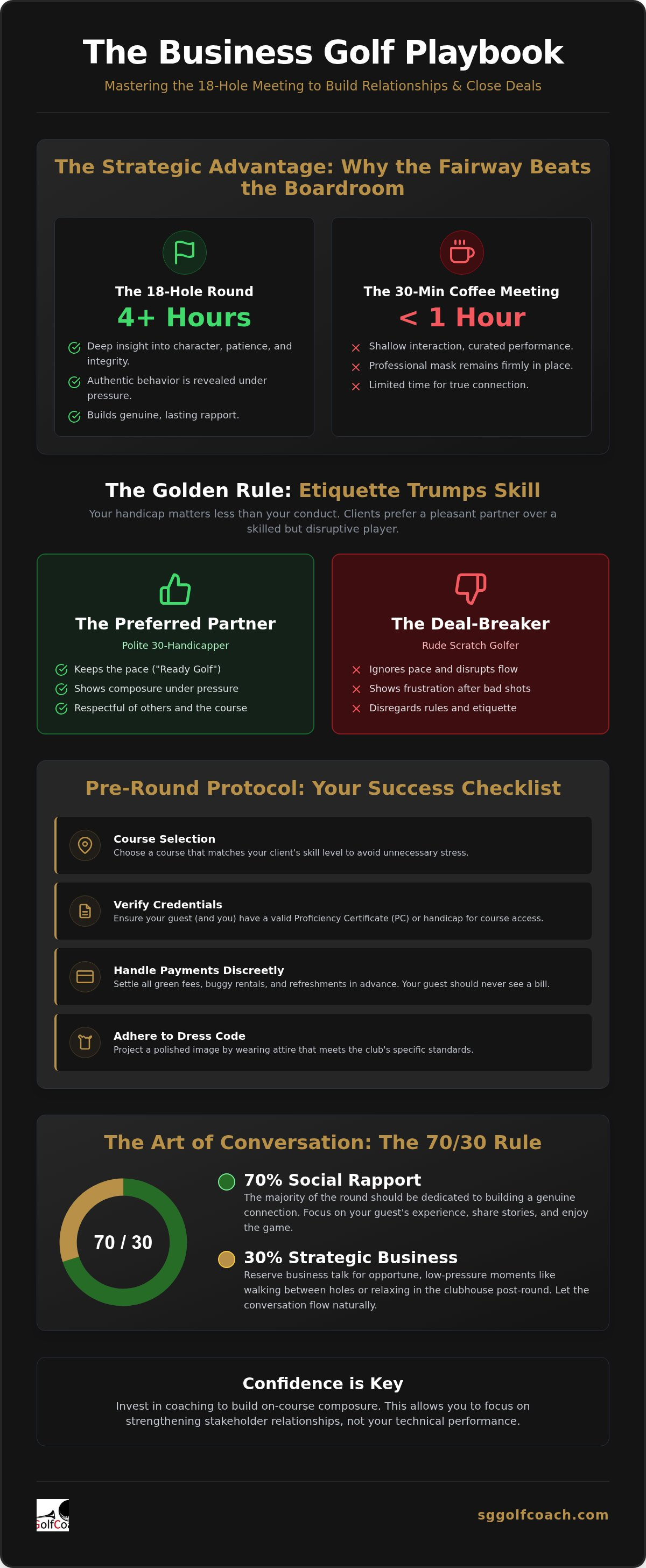
You don't need to be a professional athlete to impress a client. In fact, most executives would much rather play with a polite 30-handicapper who keeps up the pace than a rude scratch golfer who ignores the fundamental rules of golf. Your adherence to these customs signals your professional integrity. If you're honest about your score and respectful of the course, a client assumes you'll bring that same honesty to a S$500,000 partnership. Composure is your greatest asset. By staying calm under the pressure of a difficult bunker shot, you project the image of a leader who can navigate complex market fluctuations without flinching.
Setting Your Objectives for the Round
Pre-Round Protocol: Setting the Stage for Success
Planning a successful outing begins with meticulous attention to detail long before you reach the first tee. As the host, your primary responsibility is to select a course that aligns with your client's skill level. Choosing an overly punishing championship course for a high-handicapper can create unnecessary stress, which defeats the purpose of building rapport. In Singapore, verifying your guest’s Proficiency Certificate (PC) or handicap is a critical step to ensure they can legally access the course. This avoids the profound embarrassment of being turned away at the registration counter. If you're unsure about your own standing, securing a PC & Handicap through professional guidance ensures you're fully prepared to lead the flight.
The financial aspect of the day, often called the "payment dance," should be entirely invisible to your guest. A seasoned professional handles green fees, buggy rentals, and even initial refreshments discreetly in advance. Your guest should never have to reach for their wallet at the pro shop. This level of foresight demonstrates your ability to manage complex projects with ease. Adhering to essential golf etiquette also extends to your attire. Ensure your clothing aligns with the specific club's standards, typically requiring a collared shirt and tailored trousers, to project a polished and respectful image from the moment you step out of your car.
The Logistics of the Invite
When extending the invitation, clarity is your best tool for making a client feel comfortable. Avoid being overly aggressive; instead, frame the round as a chance to enjoy the outdoors while catching up. Check the club's 2026 guest regulations to ensure your visitors are fully compliant with any updated entry requirements. Provide your client with a concise brief 48 hours prior to the tee time. This message should include the exact location, the meeting time, and a gentle reminder of the dress code. It eliminates guesswork and allows them to focus on the upcoming conversation.
Arrival and the 'First Impression' at the Clubhouse
The "15-minute rule" is non-negotiable for the host. You must arrive at least 15 minutes before your guest to finalize the check-in and secure the buggies. Handling the bag drop and locker room protocol with quiet efficiency marks you as a regular, which subtly boosts your authority. Once your guest arrives, guide them through the facility with confidence. While a brief warm-up on the range is helpful, avoid over-practicing. Spending an hour hitting balls while your client waits is poor form. Instead, use the practice green for a few light putts, providing a relaxed space for initial social pleasantries before the round begins.
Navigating the 18-Hole Litmus Test
Once you step onto the first tee, the real evaluation begins. Maintaining an efficient pace of play is the most critical aspect of golf etiquette for business meetings. While traditional "honors" (where the lowest score on the previous hole hits first) is a respectful nod to history, modern business golf in Singapore favors "Ready Golf." If you're ready and the way is clear, take your shot. This prevents the round from stretching beyond the standard four hours, showing your client that you value their time as much as your own. A slow round is often a frustrating round, and you never want a potential deal to be associated with a sense of impatience.
On the green, generosity is a powerful tool for building rapport. Don't be the person who makes a client sweat over a two-foot putt. Offering a "gimme" is a small gesture of goodwill that can ease tension and keep the mood positive. Conversely, keep your mobile phone in your bag. Treating the fairway as a phone-free zone signals that the person in front of you has your undivided attention. If you face a "blow-up hole" where everything goes wrong, keep your head high. Picking up your ball and moving to the next hole after reaching double par is far more professional than throwing a tantrum or slowing down the group behind you. Your ability to recover from a bad shot with a smile says more about your leadership than a birdie ever could.
Silence and Positioning
Stand where you're neither a distraction nor a danger. This means staying out of your client's line of sight and remaining perfectly still while they swing. Silence is mandatory during the address. A simple "great shot" or "nice out" is often enough to show you're engaged. Avoid the temptation to provide unsolicited advice. Even if you've invested in Bespoke Coaching to refine your own game, your role today is that of a partner, not an instructor. Let them play their game while you focus on the conversation.
Honesty and the Scorecard
Integrity is the currency of the fairway. Counting every stroke, including those painful penalties in the water hazards, demonstrates an unwavering commitment to the truth. If a client sees you "shaving" a stroke off your score, they'll inevitably wonder if you'll cut corners in a future contract. If you notice a client being creative with their own math, stay silent. Observe their choices; it tells you everything you need to know about how they might behave in a high-pressure business negotiation. Your honesty stands as a silent testament to your professional character.
The Strategic Conversation: When to Talk Business
The 70/30 Rule serves as your tactical compass for every round. It dictates that 70% of your time should be spent cultivating a genuine personal connection, leaving only 30% for professional matters. Forcing a sales pitch on the first tee is a common mistake that can alienate a client before they've even warmed up. Instead, use the early holes to find common ground outside of work. Understanding golf etiquette for business meetings means recognizing that the sport is a vehicle for trust, not just a venue for a presentation. If your client is struggling with their swing, it's often best to keep the conversation light and supportive, deferring business talk until they find their rhythm.
Identifying the right physical "zones" for conversation is equally vital. The "Tee Zone" and the "Green Zone" are areas of high concentration where silence is a sign of respect. These are not the places for budget discussions. The "Fairway Zone," particularly the walk between shots, is your window of opportunity. This is where the most productive "walk and talk" sessions happen. By observing your guest's body language, you'll know if they're open to a professional update or if they'd prefer to focus entirely on their next approach shot. If you find yourself too anxious about your own game to lead these conversations, investing in Bespoke Coaching can provide the technical confidence needed to keep your focus on your client.
The 'Walk and Talk' Strategy
Effective communication on the course relies on subtlety and timing. Use the transition from the tee to the ball to share brief, high-level updates rather than diving into dense technical details. This is the time for open-ended questions that allow the client to lead the narrative. You might ask about their long-term vision for a project or their thoughts on a recent industry shift. Keep the dialogue fluid and unhurried. If a conversation becomes too complex, gently suggest that you'll follow up with the specific data points once you're back at the clubhouse.
The 19th Hole: Closing the Deal
The transition from the 18th green to the clubhouse lounge, traditionally known as the "19th hole," is where the real business is often finalized. This relaxed environment is the ideal setting to summarize the day's casual discussions and set clear next steps. It's the most appropriate time to ask for a formal follow-up meeting or to finalize a verbal agreement. Professionalism doesn't end when the clubs are put away; the "Thank You" protocol is the final touch. A personalized follow-up note or email sent within 24 hours reinforces the rapport you've built and confirms your reputation as a meticulous and thoughtful partner.
Confidence Through Coaching: Preparing for the Big Meeting
Your swing is often the first thing a client notices, but your composure is what they'll remember long after the 18th hole. If you're constantly worried about topping the ball or slicing into the trees, you won't have the mental capacity to lead a strategic discussion. Investing in professional instruction is a strategic career move, not just a weekend hobby. It removes the "Golf Anxiety" that plagues many executives, allowing you to focus entirely on your guest. Achieving your PC handicap golf Singapore serves as a formal validation of your skills. It signals to your peers that you've mastered the fundamentals and possess the discipline required to navigate a premium course with confidence.
Mastering golf etiquette for business meetings requires a level of self-assurance that only comes from consistent, quality practice. When you know your game is stable, you can relax into the social flow of the flight. This technical foundation allows you to project an image of success and reliability, mirroring the qualities your clients look for in a business partner. A well-prepared golfer is a well-prepared professional.
Bespoke Coaching for Busy Professionals
Standard group lessons often fail to address the specific needs of a corporate leader who needs results quickly. Bespoke coaching focuses on fixing "embarrassing" swing flaws that could undermine your professional image during a high-stakes meeting. These sessions prioritize building a repeatable, reliable swing that holds up under pressure. Additionally, incorporating golf course management lessons Singapore ensures you understand how to navigate the terrain efficiently. This knowledge directly impacts your pace of play, ensuring you never frustrate a client by spending too much time in the bunkers or searching for lost balls.
Indoor Practice for Low-Pressure Mastery
High-end simulators provide a private, low-pressure environment to refine your game away from the watchful eyes of the public. Utilizing indoor golf Singapore allows you to receive data-driven feedback that fast-tracks your progress. You can practice difficult shots repeatedly until they become second nature, ensuring that your first drive on the actual course is executed with precision. This controlled setting is perfect for busy executives who need to squeeze in a productive training session between meetings. It’s the ultimate way to build the muscle memory required for on-course success.
Ready to impress your next client with a polished game and unwavering composure? Book a bespoke coaching session today and transform your time on the fairway into a powerful business asset.
Step Onto the First Tee with Total Composure
Business golf isn't about the scorecard; it's about the connection. By mastering the nuances of golf etiquette for business meetings, you demonstrate the integrity and patience that partners look for in a leader. Whether it’s managing the pace of play or knowing exactly when to transition from social rapport to strategic discussion, your behavior on the fairway serves as a powerful professional endorsement. Just as a sharp, well-maintained appearance from Ron The Barber NYC signals authority in the global business world, your conduct on the green reinforces your reputation as a disciplined leader. You've learned that the "litmus test" of the course reveals more than any boardroom presentation ever could.
Confidence is the foundation of this success. When you aren't distracted by technical flaws, you can devote your full attention to the relationship at hand. SgGolfCoach offers bespoke adult coaching programs designed specifically for busy professionals. With expert instructors at our premier training facilities and access to indoor luxury simulator facilities, you can refine your game in a private, high-performance setting.
Refine your game for the boardroom-book professional coaching with SgGolfCoach
The green is waiting. With the right preparation and a respect for the game’s traditions, your next round won't just be a game; it'll be your most productive meeting of the year.
Frequently Asked Questions
What is the most important golf etiquette rule for business?
Pace of play is the absolute priority. Keeping up with the group in front ensures your client doesn't feel rushed or frustrated by slow progress. In Singapore's busy clubs, "Ready Golf" is the standard for golf etiquette for business meetings. This shows you respect everyone's time and can manage a schedule effectively. Integrity regarding your score is a close second, as it directly reflects your professional trustworthiness.
Should I let my client win the golf match?
No, you should never intentionally lose or "throw" a game. Clients are successful professionals who value authenticity and genuine competition. If they realize you're playing poorly on purpose, it can damage your credibility and appear patronizing. Instead, play your best while remaining a gracious and encouraging companion. Focus on the quality of the interaction rather than the final tally on the scorecard to build a lasting rapport.
When is the best time to bring up a business proposal during a round?
The best time for a formal proposal is usually at the "19th hole" in the clubhouse lounge after the round. During the 18 holes, focus on building a personal connection and discussing high-level industry trends. Use the walk between shots for light professional updates, but wait until the clubs are put away for detailed negotiations. This allows your guest to enjoy the game without feeling pressured during their swing.
What should I do if I am a much better golfer than my client?
Play your normal game without being flashy or offering unsolicited advice. It's important to remain humble and focused on your guest’s enjoyment rather than your own skill level. Avoid the "coaching trap" unless they specifically ask for a tip. By playing efficiently and staying quiet during their shots, you project a composed image. If the skill gap creates anxiety, suggest a round at a premium indoor simulator to level the playing field.
Is it okay to use my phone for work during the 18 holes?
Keep your phone in your bag and set to silent for the duration of the round. Using a mobile device on the course signals that your client doesn't have your full attention, which can be perceived as disrespectful. If you must check an urgent message, wait until you are between holes and do so discreetly. The goal of golf etiquette for business meetings is to provide a dedicated environment for relationship building without digital interruptions.
How do I handle paying for the round without making it awkward?
The host should always handle all green fees, buggies, and refreshments discreetly before the guest even arrives at the clubhouse. Arrive 15 minutes early to settle the bill at the pro shop. This eliminates the "payment dance" and ensures a seamless experience for your client. By taking care of the logistics in advance, you demonstrate superior organizational skills and a high level of hospitality that reflects well on your professional brand.
What is the appropriate dress code for a business golf meeting in 2026?
Adhere strictly to the specific club's regulations, which typically require a tucked-in collared polo shirt and tailored trousers or golf shorts. In Singapore, UV-protective fabrics are highly recommended due to the tropical climate. Avoid denim, cargo shorts, or overly casual athletic wear. Your attire should be polished and professional, signaling that you respect the traditions of the sport and the prestige of the venue where the meeting is taking place.
Do I need a golf handicap to play a business meeting round?
Yes, a valid handicap or Proficiency Certificate (PC) is usually mandatory to access most 18-hole courses in Singapore. Having these credentials proves you have the basic skills and knowledge of the rules to play safely and maintain the pace. If you don't have one, it's best to secure your PC and handicap through professional coaching before inviting a client. This prevents the potential embarrassment of being denied entry at the registration desk.


Comments