

From Driving Range to Golf Course: How Conditions and Access Differ

The range is useful for refining your swing, but it cannot fully prepare you for the decisions and changing conditions of a real round. The from driving range to golf course transition is smoother when practice goes beyond repeating the same shot: range balls may be limited-flight, while course play asks you to choose targets, adapt to lies, and manage each hole.
Focused, repeatable practice has clear value, but it is normal for confidence to feel different when every shot has a consequence and the next lie is uncertain. Neither setting is better for every goal. The range helps you work on technique; the course develops skills that a practice bay cannot fully reproduce.
This guide compares the conditions, benefits, drawbacks, and access involved in range and course play in Singapore, then explains how to carry your practice onto the course. Balancing the two matters because a typical round lasts between four and four and a half hours, according to the United States Golf Association. That time brings a different rhythm, challenge, and opportunity to learn.
Table of Contents
Differences between range and course conditions
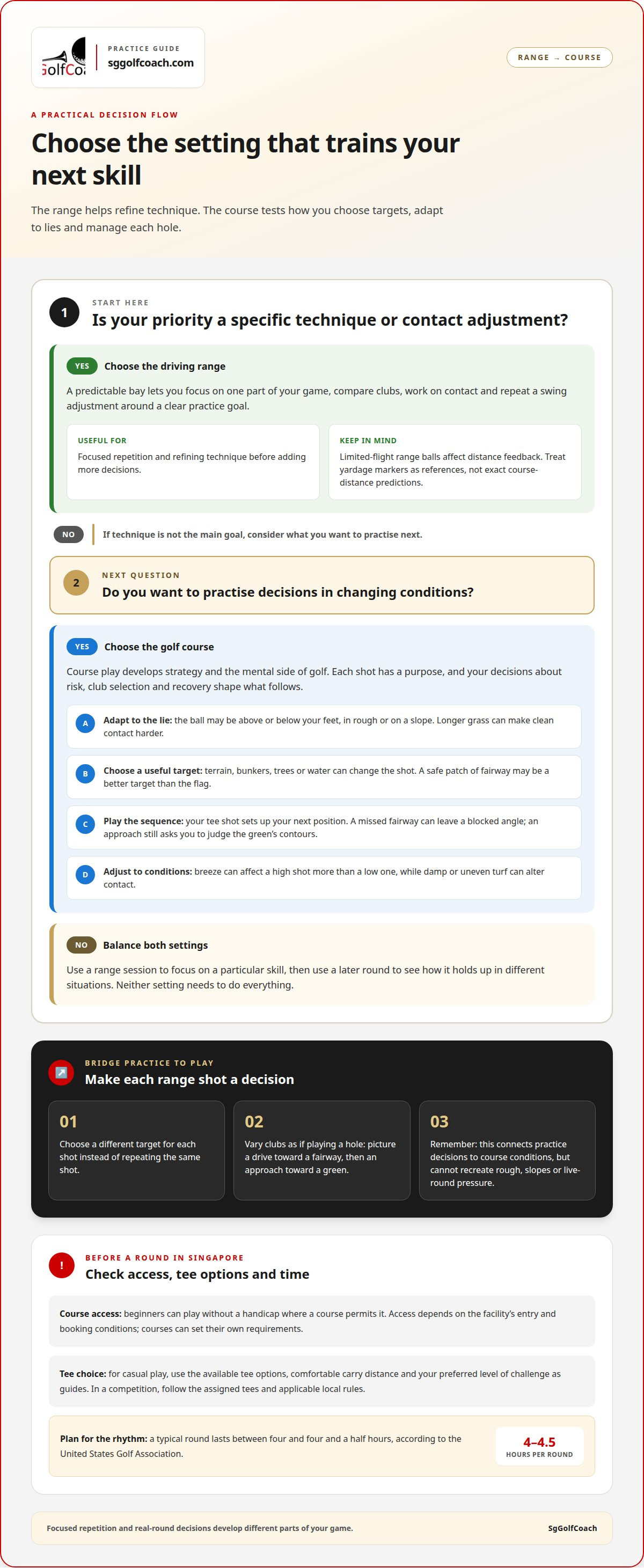
At a driving range, each shot starts from a marked bay and faces a fixed target. Range balls are typically limited-flight to keep them within facility boundaries, which affects distance feedback. A seven-iron that lands short of a target may reflect the ball, the strike, or both. Treat yardage markers as references, not exact predictions of course distance.
A range also offers a predictable stance. You usually hit from a level mat or prepared turf, with the ball placed where you want it. On a course, the ball may sit above or below your feet, rest in rough, or lie on a slope. For example, a ball nestled in longer grass can make clean contact harder.
Targets behave differently, too. A range flag stays in place, while a course hole may sit beyond changing terrain, bunkers, trees, or water. A straight shot that reaches a distant range marker may not be the best choice around a dogleg. On the course, the useful target might be a safe patch of fairway, not the flag.
Course play also changes the sequence. At the range, you can hit several shots with one club, then switch when ready. On a hole, the tee shot determines your next position, which shapes the following shot. A missed fairway can leave a blocked angle, while a good approach still requires judging the green’s contours.
Choosing a tee box is part of matching the course to your game. For casual play, choose from the tee options provided, using comfortable carry distance and your preferred level of challenge as guides. Players in a competition should follow its assigned tees and applicable local rules. A shorter tee can make the opening shot more manageable without removing the need for good decisions.
Conditions can also change during a round. A breeze may affect a high shot more than a low one, while damp or uneven turf can alter contact. Consider a simple example: a clean range shot with a seven-iron gives way to a course lie below your feet. Adjusting your stance and choosing a controlled target matters as much as repeating the same swing.
To make range practice more representative, choose a different target for each shot and vary clubs as if playing a hole. Picture a drive toward a fairway, then an approach toward a green. This routine cannot recreate rough, slopes, or the pressure of a live round, but it helps connect practice decisions with course conditions.
Advantages and drawbacks of each setting
The range and course each support different parts of your development as a golfer. Choose between them based on whether your priority is focused repetition, a full playing experience, or a balance of both.
Advantages of Each Setting
A driving range gives you space to focus on one part of your game without managing a full hole. You can compare clubs, work on contact, and repeat a swing adjustment while keeping your attention on a clear practice goal. This concentrated format suits golfers who want to refine technique before adding more decisions.
A golf course provides the context that practice alone cannot reproduce. Each shot has a purpose, and decisions about risk, club selection, and recovery affect what follows. Course play develops strategy and the mental side of golf, while tee options and course configurations can suit different skill levels. Playing with others can also build connection through groups, leagues, and social events.
The two settings can complement each other. A range session can focus on a particular skill, while a later round shows how that skill holds up in different situations. For example, practising controlled approach shots can help you plan more deliberately when a course presents a narrow landing area.
Drawbacks of Each Setting
A range’s consistency can limit what it teaches. Repeating shots from a similar stance does not prepare you for every uneven lie, awkward angle, or decision that arises during a round. Extended practice from mats can also strain wrists and hands, so vary the task and take breaks rather than striking balls continuously.
Course play has different demands. You cannot pause after each shot to repeat it, and a difficult result may affect your next decision. A round also asks for more time and attention than a focused practice session. If you want to work on one specific swing adjustment, changing situations may give you fewer chances to repeat that movement deliberately.
Neither setting needs to do everything. Choose the range for a specific technical focus; choose the course to practise decisions, recovery, and composure. If you spend an hour at the range, give the session a defined purpose instead of measuring progress only by the number of balls hit. A round adds the challenge of applying those skills under varied conditions.
For a more considered practice routine, explore ways to structure your golf practice around a clear learning goal.
A round may be less practical when your goal is simply to work through one focused adjustment, while a range session may suit that purpose better. At the same time, facilities can offer tee setups and course configurations for golfers with different skill levels, giving players options that fit their ability.
Range and course accessibility
Beginners can play without a handicap where a course permits it; access depends on the facility’s entry and booking conditions. A handicap is not a universal measure of whether someone can learn golf, but a course can set its own requirements for play.
That distinction matters in Singapore because range access and course access work differently. A range session usually centres on using a practice bay and hitting balls. A course visit involves a tee time, a playing format, and expectations around pace and etiquette. For a new golfer, those extra steps can feel like a bigger hurdle than the swing itself.
Start by identifying the kind of course experience you want. A casual round with a more experienced player can help you learn the rhythm of moving between holes. Beginner-friendly tournaments, scramble events, or introductory sessions can also offer a gentler first experience. In a scramble, players contribute shots to a shared team result, so a newcomer is not solely responsible for every outcome.
Some golf facilities use introductory rates or promotions to encourage range golfers to try course play. Tee options and course configurations can also make access more suitable for different skill levels. For example, a beginner can choose a shorter tee setup when available, reducing the distance to cover without changing the basic etiquette or decisions involved in a round.
Course access involves more than booking. Players need to know when to take a shot, how to keep pace, and where to stand while another golfer plays. For example, wait until the group ahead is clear before hitting, and be ready when it is your turn. These habits help make a first round feel organised for the whole group.
Handicap questions often arise before booking. A handicap records playing ability, while access rules belong to the course. If you do not yet have a handicap, the practical question is whether the selected course and format accept beginners without one. SgGolfCoach’s PC & Handicap service supports golfers with handicap-related needs as they develop.
For a lower-pressure bridge, practise at a range first, then join a casual round with someone who knows course etiquette. Choose one manageable goal, such as keeping up with the group or selecting a safe target. Afterward, note one unfamiliar decision, such as choosing a club from an uneven lie. That observation gives your next practice session a clear purpose.
Access also depends on the experience you want. Some players in Asia prefer range or indoor golf and have no intention of playing on a course. That is a valid way to enjoy golf. If you are ready to play outdoors, introductory formats, suitable tees, and clear etiquette can make the first step more approachable.
Transitioning from range to course
A confident first round depends on more than a repeatable swing. Think of the from driving range to golf course transition as learning to apply your practice while making decisions, following etiquette, and preparing for changing situations.
Skills for a First Round
First-round skills include choosing a target, selecting a sensible club, and following a steady pre-shot routine. Practise aiming each range shot at a specific target instead of hitting without a clear intention. Then vary the club and shot type so practice involves decisions as well as ball striking.
Keep swing thoughts simple. Tim Mahoney’s study found that 80 percent of golfers had less hip turn on the course than at the range. Carry one or two familiar swing thoughts, such as keeping your balance or finishing smoothly, rather than making several technical changes during play.
For good etiquette and pace, be ready while others play, stand clear of their swing, and move promptly between shots. Avoid distracting another player who is preparing to hit. If your group falls behind while searching, keep decisions focused and let following players continue when appropriate and safe.
To book and prepare for a first course visit in Singapore, choose a course and format, then use its booking process to arrange a tee time. Review the facility’s entry conditions, dress expectations, and booking instructions beforehand. Allow time to check in and get ready before play begins.
What to Bring and Wear
Bring clubs you can use comfortably, golf balls, tees, a ball marker, and a glove if you prefer one. Wear clothes that allow a full swing and footwear suited to walking on grass. Dress expectations differ between facilities, so follow the instructions provided for your booking.
For Singapore’s outdoor conditions, pack water and sun protection. A towel can help clean your hands or clubs, while keeping small items together makes them easier to reach. Carry only what you need to keep moving between shots straightforward.
Beginners commonly face unfamiliar lies, uncertain club choices, and pressure after a poor shot. Choose a safe target, select a club you can control, and return to one familiar swing thought. If a shot goes astray, aim for a playable next position instead of attempting a difficult recovery.
The from driving range to golf course transition becomes more manageable when each round informs your next practice session. After playing, note one situation that challenged you, such as judging a sloping lie or choosing a safe route around an obstacle. Practise that decision or shot deliberately, then apply it during your next round. Progress comes from connecting practice with real course choices.
What skills should beginners master before playing their first round of golf?
Before your first round, focus on skills that help you make a useful next shot, rather than perfecting every club. Choosing targets, following a steady routine, making basic club selections, and noticing other players all make the course easier to manage.
Choose a target. At the range, aim each shot at a specific marker or landing area. On a course, that same habit helps you plan beyond the flag. If trees narrow the route, choose a safe section of fairway rather than forcing a shot through a gap. A clear target gives your swing a purpose and helps prevent last-second changes.
Build a repeatable routine. Use the same simple sequence before each shot: assess the lie, choose a target, select a club, then settle into your stance. Keep your attention on one or two swing thoughts, such as balanced posture or a smooth finish. A short routine is easier to recall under pressure than several technical reminders.
Practise more than full swings. A first round includes chips, pitches, and putts, not just tee shots. On the practice green, roll putts toward a chosen target and notice how pace affects distance. Near the green, practise a controlled chip that lands safely and rolls forward. These touch shots can help you recover when an approach misses the putting surface.
Learn sensible club selection. Choose a club you can control for the situation rather than chasing maximum distance. For example, a shorter club may be wiser when a narrow landing area lies ahead. If the lie is uneven, prioritise solid contact and a safe direction. Good course management often means accepting a straightforward next shot instead of attempting a difficult recovery.
Understand pace and etiquette. Be ready while another player takes a shot, stand outside their line of play, and move efficiently between shots. If your group is delayed by a search, avoid turning one missed ball into several slow decisions. Keep your clubs organised and decide your next shot as you approach the ball, without distracting a player preparing to swing.
These skills work together. A repeatable routine supports target choice; target choice informs club selection; and a steady pace gives you time to think without holding up the group. After a round, identify one unfamiliar situation, such as a bunker shot or a long putt, and practise it before playing again.
Build these habits into your next practice session with a more course-focused practice routine.
On the course, one or two swing thoughts can help you repeat what you practised at the range, even when each shot calls for a fresh decision.
SgGolfCoach: Screen Golf Booking
SgGolfCoach offers Screen Golf Booking for golfers who want an indoor setting to practise between course rounds. It can suit players building familiarity with golf before trying outdoor play, or those who want to maintain a regular practice rhythm. Adult Lessons and Junior Programs provide coaching for different stages of learning, while PC & Handicap supports golfers working on handicap-related needs.
Choose the option that matches your next step: practise indoors, develop your technique through lessons, or address handicap matters as your game progresses. Range work and screen golf can support skill development, while playing on a real course remains valuable for learning decisions and etiquette in context.
Make your next practice count
Your next step does not need to be a perfect round. Choose one area to develop, then give it attention in a setting that supports your goal. If you are building confidence before outdoor play, Screen Golf Booking offers an indoor option; Adult Lessons and Junior Programs provide coaching for different stages of learning.
The aim is steady progress, not mastering every shot before you begin. A clear practice focus can make the from driving range to golf course transition feel more purposeful. Each round also gives you fresh situations to learn from, so let experience guide what you practise next. Treat the transition as a gradual process, shaped by manageable goals and the confidence to keep learning.
Whether you’re planning your first round or refining your routine, take a considered next step with SgGolfCoach and plan your next steps. Begin with one practical goal, then build on it at your own pace.
Frequently Asked Questions
Is It Better to Practice on the Range or Course?
Neither setting is better for every goal; choose based on the skill you want to develop. If you are changing your grip, the range lets you focus on that adjustment without managing a hole. If you are learning to recover from a poor shot, course play gives you a decision to make. A useful approach is to pair focused practice with rounds that reveal which skills need more attention.
How do I know when I'm ready to move from the driving range to a golf course?
You are ready to try a course when you can make a controlled swing, move safely around other players, and accept that some shots will not go as planned. You do not need to hit every target or use every club confidently. For example, choosing a safe direction after a wayward tee shot is a skill that matters during a round. Choose a beginner-friendly format and follow its entry conditions.
How is practice on a driving range different from playing on a golf course?
Range practice lets you reset after each shot; a course asks you to play each result forward. A topped tee shot, for example, may leave you with a shorter next shot rather than a chance to repeat the drive immediately. The course also connects shots into a full sequence, from tee to green, including putting and scorekeeping. That sequence makes decision-making part of the practice.


Comments