

Group vs Private Golf Lessons: Compare Costs and Feedback

Private lessons aren’t automatically the better starting point. Group lessons generally cost less per session and offer a social learning environment, while private coaching gives the instructor more time to focus on your technique and goals. The pros and cons of group versus private golf lessons depend on the feedback, pace and learning experience that suit you.
It’s understandable to weigh the cost against the attention you’ll receive, especially when you’re building confidence or working through a swing challenge. Both formats can support progress, and combining them offers a practical middle ground: learn general skills alongside others, then use private sessions to focus on areas that need more attention.
This guide compares group and private lessons by cost, feedback, learning style and scheduling, then explains when each approach may fit. You’ll also see how to combine the two as your skills and goals evolve.
Table of Contents
Choosing lessons based on goals, budget, and learning style
In Singapore, choose a coach or lesson package by matching its format to your goal, preferred learning style and need for individual feedback. Consider how group size affects attention, whether you learn well alongside others, and whether shared lessons or tailored coaching better suit your priorities.
Group Affordability and Social Learning
Group lessons generally cost less because golfers share the coach’s time rather than receiving individual attention throughout the session. They can suit beginners learning fundamentals and adults who enjoy practising socially. For example, a learner who wants to build confidence through shared activities may value the group atmosphere more than uninterrupted one-to-one attention.
Group size influences the experience: lessons commonly have 4 to 8 students per instructor, while beginner classes often cap enrolment at 6. A smaller group can leave more room for individual guidance; a larger group may offer more chances to observe different swings. Consider how much direct feedback you need before choosing this more affordable format.
Peer Learning and Golfer Connections
Learning alongside other golfers lets you watch how classmates approach a drill and compare what feels comfortable in your own swing. A beginner working on grip or posture, for instance, can observe how a peer applies the coach’s instruction. That shared perspective adds a social dimension that private lessons, centred on one learner, don’t provide in the same way.
Group practice can help golfers meet others at a similar level and share common challenges, such as building confidence with a new club. Those conversations can make lessons more engaging and help participants find practice partners. Choose a group if observation and interaction motivate you; choose individual coaching if peer activity distracts you from your main goal.
Start by naming one priority for your next lesson: learning fundamentals, correcting a particular habit or becoming more comfortable practising with others. Then match the format to that goal. A golfer seeking help with a specific putting issue may value tailored feedback, while someone learning basic setup may benefit from seeing classmates practise the same sequence.
For a Singapore lesson package, look at how its teaching approach fits your experience and the attention you expect. Ask yourself whether a group of 4 to 8 would help you learn through observation, or whether you need a golf coach focused on your individual challenges. The right choice depends on the lesson’s learning environment, not simply its format.
Choose the format that best supports your immediate learning goal, preferred level of interaction and need for tailored feedback.
What Are Private Golf Lessons?
Private golf lessons give a coach time to focus on one golfer’s needs, technique and goals. Their main advantages are personalised feedback and individual attention. The trade-offs are less peer interaction than in a group lesson and, for some learners, a more pressurised setting.
How Individual Feedback Supports Improvement
In private instruction, the coach can observe your swing and respond immediately instead of dividing attention among several students. If your ball keeps slicing, for example, the coach can examine your grip, posture and swing path, suggest an adjustment and watch your next shot. This makes the feedback specific to your movement.
Personalised attention can also shape a lesson around a particular skill, such as putting, chipping or bunker play. A golfer working on short putts can focus on pace and aim, while someone struggling with bunker shots can practise setup and contact. The coach can adjust the instruction as each challenge arises.
That responsiveness is useful for beginners who want to discuss situations they encounter while learning or practising. Instead of waiting for the coach to work around a group, you can ask a question when it comes up. Immediate instruction connects the explanation to the shot you just played, making the feedback easier to apply.
How Group Attention Differs
Group lessons still provide instruction, but the coach’s time is shared. Groups commonly have 4 to 8 students per instructor, so each golfer may need to wait while classmates practise or receive feedback. You can still get individual guidance, though the amount of direct attention differs from a one-to-one session.
A group of more than 10 students per instructor may lean toward demonstrations rather than individual instruction. That distinction matters if you need a coach to analyse a recurring swing pattern or adjust your posture during practice. For a general lesson on grip or alignment, observing a demonstration may be useful; for a persistent miss, focused feedback may suit you better.
Balance Focus With Comfort
One-to-one coaching can feel intense because the lesson centres on your shots. If that pressure makes you tense, tell the coach what you find difficult and choose a manageable focus, such as chipping before tackling a broader swing issue. Clear goals help keep the session purposeful.
Choose private lessons when detailed feedback, real-time adjustments, or a specific skill are your priority. If you want focused adult golf lessons, an individual session can centre instruction on your learning needs.
Limitations of group feedback for specific swing problems
For faster, more individual feedback, private lessons let a coach focus on one golfer’s swing and make adjustments in real time. Group instruction divides attention among students, so golfers may wait for feedback. It remains useful for shared fundamentals, but may be less suited to a persistent individual swing problem.
In a group setting, one demonstration may not explain why two students produce different shots. A golfer who slices may need a grip adjustment, for example, while a classmate’s slice may involve posture or swing path. A coach can introduce a shared drill, but identifying each cause requires individual observation and feedback.
Group lessons commonly have 4 to 8 students per instructor, so coaching time is shared across the class. While one student practises, others may observe or repeat the drill. This creates opportunities to learn from demonstrations, but it also means you may not receive a correction after every shot, especially when several students need guidance.
Class size matters. A group with more than 10 students per instructor may provide demonstrations rather than individual instruction. If you’re working on a recurring miss, such as striking the ground before the ball, that format can leave less room to examine your swing, identify the cause, and practise a specific correction with the coach.
Private coaching supports a more focused correction process. The coach can analyse your swing, adjust your posture and adapt your game strategy in real time. If your shots drift right after you change your stance, for example, the coach can observe your next swing and respond to the result rather than relying on a general tip for the group.
Use this simple sequence to decide whether group feedback is enough:
Name the pattern: Identify a repeated issue, such as topped shots or inconsistent contact.
Assess the lesson: Consider whether a shared drill addresses the issue or whether it needs swing-specific analysis.
Choose the format: Prefer group coaching for common fundamentals; use private feedback for a personal pattern needing targeted correction.
Personalised instruction can also help golfers who have plateaued and need feedback based on their own performance. If practice keeps producing the same miss, a private session can focus on that pattern, test adjustments and set a clear practice priority. Group lessons remain valuable for general skills and peer learning, while individual analysis gives the coach more opportunity to address a specific flaw.
Private golf lessons provide personalised feedback on a golfer’s swing pattern and goals. They give the coach more opportunity to identify and address inconsistencies in a learner’s technique or strategy.
Choosing lessons based on preference, budget, and availability
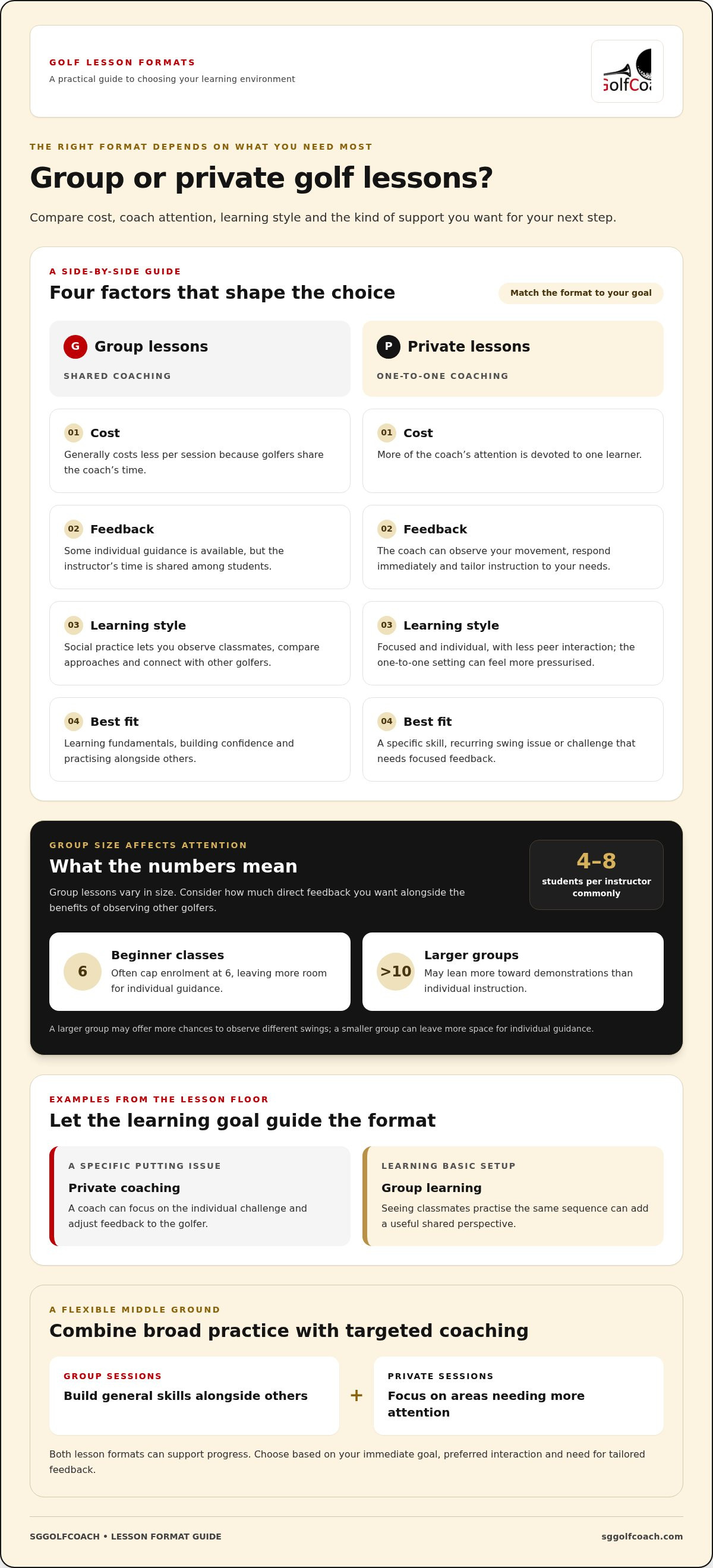
Choose a lesson format by weighing three practical factors: your current goal, preferred learning environment, and available time. Group sessions generally cost less per session, while private coaching costs more because the coach’s attention is focused on one golfer. In Singapore, compare those trade-offs against the progress you want from each session, not price alone.
Begin with one clear target for the next 30 days. For example, a new golfer might focus on grip and setup, while an intermediate player may want to refine an inconsistent approach shot. A group lesson can suit shared fundamentals; private coaching may better address a specific weakness that needs a tailored plan.
Skill level can guide your first choice. Beginners often benefit from group programmes that introduce golf fundamentals in a shared setting. These beginner programmes typically run for 4 to 6 weeks, giving learners a sequence of sessions rather than a single introduction. A golfer who already understands basic technique may prefer private instruction to focus on details needing individual attention.
Consider the calendar as well as the lesson format. Group lessons may be less flexible because learners attend a shared class, while private lessons typically offer more scheduling flexibility. If work or family commitments change from week to week, individual coaching may fit more easily. If you can commit to a regular class time, group learning can provide consistent structure.
For recreational golfers, one possible rhythm is a lesson every two weeks, paired with intentional practice. Use the time between sessions to work on one instruction point, such as maintaining your balance through the swing. This helps you arrive with a clear update or question, whether your next session is private or shared.
Use this short decision process before booking:
Set the goal: Choose a specific skill or learning milestone for the next 30 days.
Match the format: Select a group for shared fundamentals, or private coaching for a targeted weakness.
Review your schedule: Decide whether a shared class time or more flexible individual sessions work better.
Plan practice: Choose one lesson takeaway to work on before the next session.
A typical group series runs for 4 to 8 sessions, so consider whether that commitment suits your calendar and learning pace. If the goal is broad development, a series can provide a clear progression. If you want to refine one part of your game, private lessons can keep the session focused on that priority. Let your goal, budget, and availability determine the balance.
Combining private and group lessons
You don’t have to choose one format for every stage of your golf development. Group clinics can build general skills and confidence alongside other players, while private lessons give focused attention to technique or a personal challenge. Together, they offer a flexible approach for golfers who don’t want every session to serve the same purpose.
Start with the skill you want to develop. If you’re new to golf, a beginner clinic can introduce fundamentals in a shared learning environment. As your swing becomes more consistent, private coaching can focus on details such as posture, contact or a recurring miss. Your lesson format can change as your skill level and goals evolve.
One possible combined approach is two private lessons per month for mechanics, alongside group clinics for general skills. Use each private session to identify one technique priority, then practise it during the next group clinic. A coach might help you refine your setup privately, for example, while a group session gives you the chance to repeat that routine during broader practice.
Keep the two formats connected with a simple plan:
Set one focus: Choose a specific technique or skill for your next private lesson.
Practise the adjustment: Repeat the coach’s instruction between sessions, noting what feels consistent.
Use the group clinic: Apply the same focus during general drills and learn alongside other players.
Review your progress: Bring one question or observation to the next private session.
This approach can also help golfers who feel unsure where to begin. A clinic offers a guided introduction, while private instruction can address technical questions as they emerge. Intermediate players can reverse the emphasis: use focused coaching to address a weakness, then join group sessions to build broader skills and practise with golfers at a similar level.
Balance matters. Too many unrelated lesson goals can make practice feel scattered, so carry one clear takeaway from private coaching into your next group session. If the coach adjusts your swing path, for instance, avoid adding several mechanical changes before practising that adjustment. A focused plan helps each format support the other.
For adult golfers, explore adult golf lessons as a way to build a learning plan around shared practice and focused coaching. The key is to use group sessions for broad development and private lessons for targeted improvement, adjusting the balance as your needs change.
SgGolfCoach: Junior Programs
SgGolfCoach offers Junior Programs for young golfers developing their skills, alongside Adult Lessons for learners seeking coaching suited to their experience. If you’re choosing between shared learning and individual attention, its golf coaching includes group classes and one-to-one sessions, so you can match the format to the learner’s needs.
For juniors, a group setting can make learning golf a shared activity, while individual coaching can focus more closely on technique or a particular challenge. Adults can also develop their game through lessons, and Screen Golf Booking offers an indoor golf experience. PC & Handicap supports golfers with their golf records and handicap needs.
Consider which format best fits the player’s goals, then visit sggolfcoach.com to explore the next step.
Choose a Lesson Path That Grows With You
Your next step doesn’t need to lock you into one way of learning. Treat your lesson choice as adjustable: begin with a manageable format, then reassess when your goals or confidence shift. Understanding the pros and cons of group versus private golf lessons can help you choose deliberately, rather than assuming one format suits every stage.
Before your next session, write down one skill you want to develop and one question for the coach. That small preparation gives the lesson direction and helps you decide whether shared practice, focused individual coaching or a blend makes sense for your current needs.
If you’re ready to shape a learning plan for yourself or a junior golfer, contact SgGolfCoach to discuss lessons. A thoughtful next step can turn practice into purposeful progress, one skill at a time.
Frequently Asked Questions
Comparison: Which path fits your goals?
Choose the lesson format that matches what you want to change next. If you want to become comfortable with golf basics and enjoy learning alongside others, a group class may be a natural fit. If you want to address a recurring issue, such as losing balance at the finish, consider private coaching. The pros and cons of group versus private golf lessons become clearer when you first define a specific learning goal.
Which Should You Choose?
Choose based on the support that would help you make the most of your next practice session. If you have a specific question, such as how to improve contact with an iron, private instruction can focus on it. If you’d rather learn through shared drills and interaction, a group class may suit you. After the lesson, note what you’ll practise and consider whether the format helped.
What are the pros and cons of group golf lessons?
Group lessons can make golf more social and give students the chance to practise alongside others and observe how classmates approach a drill. The trade-off is that the instructor’s attention is shared, so a personal question may have to wait. Before joining, consider whether you’re comfortable learning in a group and whether your main goal involves shared fundamentals or an individual challenge.
Are group or private golf lessons better for beginners, children, or experienced golfers?
Either format can suit different ages and abilities, depending on the learner’s needs. A beginner who enjoys joining in may find a group introduction welcoming, while a child who needs close guidance may benefit from more individual attention. An experienced golfer working on one weakness can use private coaching to focus practice. Group sessions can still suit learners at any level who value social learning.
Can golfers combine group and private lessons for better results?
Yes. Give each format a distinct purpose, then connect them with one practice focus. For example, you can work on a swing adjustment privately with a coach, then practise it during shared group drills. After each lesson, briefly note what felt effective and what remains difficult. This gives your next session a clear starting point without repeating earlier work.



Comments