

Is a Golf Coach Worth the Money? Weigh the Cost and Progress

A golf coach is worth the money when you have a clear goal and are ready to practise between lessons. Coaching helps you identify what to work on instead of repeating habits that aren’t moving your game forward. A lesson alone, however, is unlikely to create lasting change.
It’s reasonable to weigh the cost carefully, especially if you’re unsure how often you’ll play or practise. The value depends on what you want to improve, how focused the coaching is, and whether you can apply the guidance between sessions.
This article explains when lessons may justify the expense and when they may not suit your goals. It also covers what to look for in a coach, how to think about lesson frequency, and how tailored coaching in Singapore can support progress at a pace that works for you.
Table of Contents
1. Are golf lessons worth the money?
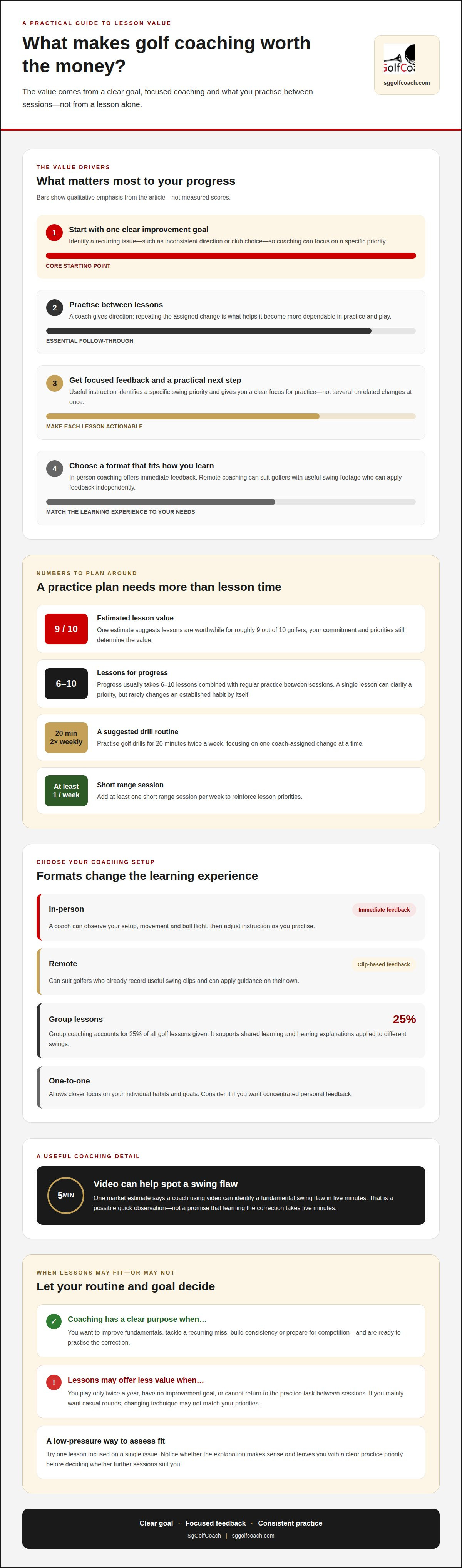
Golf lessons are most valuable when they address a specific goal and shape what you practise next. An estimate suggests lessons are worthwhile for roughly 9 out of 10 golfers, but value depends on your commitment and priorities. A golfer seeking steadier contact needs different guidance from someone preparing for a competition. Before booking, identify one recurring problem, such as inconsistent direction or difficulty choosing a club.
Yes, coaching can help lower your handicap and improve consistency by identifying patterns and setting focused corrections. Progress usually takes 6-10 lessons combined with regular practice between sessions. That gives a coach time to assess your starting point, introduce changes and review how they hold up. A single lesson can clarify a priority, but follow-through is what helps turn instruction into a more dependable routine.
Choose in-person coaching if you want immediate feedback while practising your swing. A coach can observe your setup, ball flight and movement, then adjust the instruction as you practise. Remote coaching can suit golfers who already record their swings and want feedback on specific clips. It depends on having useful footage and being able to apply the guidance independently. Consider which format helps you understand and practise corrections most effectively.
Group or one-to-one lessons can also change the experience. Group coaching lets you learn alongside other players and hear explanations applied to different swings. One-to-one instruction can focus more closely on your individual habits and goals. Group lessons account for 25% of all golf lessons given, showing they are a common format. If shared learning motivates you, a group may fit; if you need concentrated personal feedback, consider individual coaching.
Make practice part of the decision, not an afterthought. A useful routine is to practise golf drills for 20 minutes twice a week, then attend at least one short range session per week to reinforce lesson priorities. Use each session for one coach-assigned change rather than trying several swing adjustments at once. Regular play also reveals whether a technique holds under different lies and decisions, rather than only during a practice drill.
In Singapore, lessons at a driving range or golf academy can be good value when the setting supports your learning goal. The venue alone doesn’t determine value; clear feedback, relevant drills and a practical next step matter more. Adult Lessons provide structured guidance, while PC & Handicap support can connect coaching with tracking your playing progress. Compare the learning format with your goal, then choose the option that makes consistent practice realistic.
2. When lessons may not be worthwhile
Lessons offer limited value if you play only twice a year and have no improvement goal. Your priority may be enjoying each round, not changing your technique. Coaching involves learning a correction, remembering it and applying it during practice or play. If those steps don’t fit your golf routine, instruction may feel disconnected from the experience you want.
Commitment matters because a lesson gives you direction, not an automatic change in your swing. A single lesson rarely changes an established habit. For example, a player who returns to the same grip and setup after coaching may struggle to retain a new movement. Before booking a series, consider whether you can return to the specific practice task your coach sets.
Beginners can benefit from instruction if they want help with basics such as grip, stance and aiming. Early guidance can give practice more structure than trying several tips at once. But a beginner who wants only an occasional social round doesn’t need to treat lessons as a requirement. The decision depends on whether learning fundamentals is part of the goal, not on experience level alone.
High-handicap golfers also need a clear reason to book. If you regularly miss the ball in the same direction, coaching can help identify a priority. If you play infrequently and feel content with your game, you may value casual rounds more than technical change. Your handicap alone doesn’t determine whether lessons are worthwhile; your goals and willingness to work on a change matter more.
A trial lesson is a practical first step before booking further sessions. Focus on one issue, such as inconsistent contact, and notice whether the explanation makes sense. A useful lesson should leave you with a clear practice priority, not several unrelated swing thoughts. Afterward, decide whether the coaching approach suits the way you learn and practise.
To judge whether a golf coach is worth the money, consider what you’ll do after the lesson. If you can’t practise regularly, play only twice a year, or don’t want to change your game, lessons are less likely to match your priorities. If you’re a beginner seeking sound fundamentals or a higher-handicap golfer ready to tackle a recurring problem, instruction has a specific purpose. Let your goal, available practice time and interest in improvement guide your decision.
3. Professional coaching and swing analysis
Professional coaching turns a recurring miss into a specific issue to investigate. A golfer who keeps slicing may assume swing path is the only cause. A coach can observe setup, grip, club movement and ball flight before choosing a correction. That assessment matters because changing several things at once can make it harder to tell what helped.
Video can make your movement easier to review. A coach can compare your setup and swing motion with the resulting ball flight, then explain a useful adjustment. One market estimate says a coach using video can identify a fundamental swing flaw in five minutes. Treat that as a possible quick observation, not a promise that the full correction takes five minutes. Learning and repeating the new movement still require practice.
Useful analysis should lead to a clear sequence. First, identify the pattern, such as repeated contact toward the heel. Next, choose one correction and practise it with a simple drill. Then check whether contact changes before adding another adjustment. This keeps instruction manageable and gives the next session a concrete purpose, rather than turning each lesson into a fresh collection of unrelated tips.
Coaching frequency should match the golfer’s needs and practice capacity. One lesson per month can provide a regular review point for a player working on consistency. A golfer preparing for a tournament may consider weekly sessions in the lead-up, while a developing player might plan 4-6 lessons rather than relying on one isolated session. These are different approaches, not fixed schedules for every golfer. The key is leaving enough time to practise each priority between meetings.
Professional credentials are one consideration, alongside communication and teaching approach. Instruction should make sense to you and connect a technical observation to an action you can repeat. A reported pattern doesn’t establish that one credential or teaching style suits every learner.
For golfers in Singapore, bespoke coaching is most useful when a personal playing pattern needs focused attention. Bring a specific example, such as trouble with short irons or inconsistent contact, and use it to shape the session’s objective. A coach can relate swing observations to a practical improvement plan. If you’re weighing whether coaching is worth the money, consider whether the analysis gives you a clear correction, a way to practise it and a reason to review your progress.
4. Building fundamentals and avoiding bad habits
Fundamentals give each later swing adjustment a stable starting point. Consider grip, stance, alignment and posture before changing club movement. If your feet aim left while your intended target is to the right, your swing may compensate. A coach can help separate setup errors from movement issues, so you don’t keep adjusting the wrong part of your technique.
Early instruction can be especially useful because beginners often copy movements without knowing what each one does. Three or four early lessons can compress learning golf fundamentals from years of self-teaching into weeks. That doesn’t mean you’ll master golf in weeks. A coach can make early practice more purposeful by showing how a balanced setup and controlled motion work together.
Build one foundation at a time. Start by rehearsing a consistent grip, then add stance and alignment before focusing on a full swing. For example, if you change your grip, posture and swing path together, you may not know which adjustment changed the ball flight. Practising one clear correction makes cause and effect easier to observe. Bring what you notice to your next coaching session.
Bad habits often persist because golfers repeat the same movement without noticing its effect. A slice, for instance, can prompt you to aim farther left, creating a new setup problem. Instead, note the pattern, return to the fundamentals and work on your coach’s chosen correction. A video review can help you compare setup positions, but understanding what to change is key.
Repetition matters after instruction. Lessons alone don’t create a great swing; you need to practise the movement outside the session. Focus on the assigned drill instead of mixing advice from multiple videos or friends. If the correction feels unfamiliar, rehearse it slowly before adding a ball. This helps preserve the intended movement and reduces the temptation to return immediately to an old habit.
Use the next session to review one priority and decide whether it needs refinement or progression. Golf students may notice a change within 3-5 lessons, though the useful measure is whether the fundamentals hold during ordinary practice and play. A coach can adjust the next step if a correction causes another problem. This steady cycle, observe, practise, review, helps build a swing around repeatable foundations rather than quick fixes.
5. What extra costs come with golf lessons, such as range fees and equipment?
The lesson fee is only one part of a golf budget. A session at a driving range may involve a separate bay charge or practice balls, depending on the venue. Ask how the lesson setting handles those items before planning your spend. For example, you may pay for range time again if you practise after the lesson. Separate lesson costs from the expenses of practising on your own.
Practice balls can become a recurring expense as you work on a change. Golfers may need to hit dozens of buckets of balls at a driving range to make their swing consistent, but the amount varies. It depends on how often you practise, the drill and how quickly the movement settles. Keep a record of your sessions to see how practice affects your overall budget.
Equipment can add another expense, especially for a beginner without clubs. Start by listing what you already own, such as clubs, golf shoes and gloves. Then separate essential items for your planned sessions from optional upgrades. If you’re working on grip and posture, you may not need to replace a full set. Buying equipment before understanding your coach’s priorities can divert money from useful practice.
Travel and scheduling also shape the real cost of instruction in Singapore. A range farther from home may add transport expenses and make regular practice harder to fit into your week. Compare the whole routine, not just the lesson location. Practising near work or home may make it easier to follow through without extra journeys. Travel time can also limit how often you use a practice facility.
Build a simple budget with separate lines for coaching, range visits, balls, transport and equipment. Review it after several sessions rather than estimating from memory. If range practice takes more of your budget than expected, ask your coach to make each visit more focused. One clear drill can make practice time purposeful, while random ball-hitting can use up balls without addressing your current priority.
Choose a lesson plan that leaves room for practice expenses, rather than spending the entire golf budget on instruction. A useful approach is to set a monthly limit, record each golf-related expense and decide which activity supports your goal most. If you’re ready to align coaching with a practical budget, plan your golf lessons around the progress you want to make.
SgGolfCoach: Screen Golf Booking
SgGolfCoach offers Screen Golf Booking for golfers who want an indoor setting to practise and play. If you’re deciding whether coaching fits your goals, consider pairing screen-golf time with Bespoke Coaching, which focuses on your individual needs. This gives you a clear way to work on specific aspects of your game.
Adult Lessons offer structured guidance for adult players, while Junior Programs provide a coaching option for younger golfers. Choose based on who is learning and whether the priority is instruction, practice or both. Screen golf is also a practical option for working on your game indoors.
To discuss which option suits your goals, contact SgGolfCoach.
Make your next golf step count
Your next step can be simple: decide what you want to make easier on the course, then use that goal to guide your learning. A steadier setup, clearer club choices or more confidence with a particular shot can give coaching a practical focus. That makes it easier to judge whether a golf coach is worth the money for your priorities, rather than someone else’s expectations.
SgGolfCoach offers Adult Lessons and Junior Programs for players seeking instruction, as well as Screen Golf Booking for indoor golf. The right starting point depends on who is learning and whether the immediate aim is coaching or screen-golf practice. You can bring your goal into a conversation and explore a suitable next step without committing to a particular outcome.
Contact SgGolfCoach to discuss lessons and take a considered step toward a more confident, rewarding game.
Frequently Asked Questions
Are golf lessons worth the money?
Yes, golf lessons can be worthwhile if you want to improve and can use the guidance afterward. Consider the value of diagnosing a persistent issue, such as topping shots, rather than repeatedly guessing at a fix. Lessons may be less suitable if you play occasionally purely for leisure. The best measure is whether instruction helps you make decisions and practise with greater purpose.
How many lessons do I need to have to improve?
Lasting improvement usually takes 6-10 lessons combined with regular practice between sessions. That range is a planning guide, not a fixed requirement for every golfer. Your starting point, the complexity of your swing changes and your available practice time all matter. Ask your coach to review progress as you go, so later sessions address what you still need rather than repeating material you’ve already absorbed.
How much can a beginner improve with golf lessons?
A beginner can build more reliable fundamentals, understand basic shot preparation and get a clearer sense of what to practise. Progress depends on the learner’s goals and how consistently they apply instruction. For example, someone aiming to make cleaner contact has a different benchmark from a beginner focused on lowering scores. Set a practical measure with your coach instead of expecting a particular handicap change.
How many golf lessons does a beginner typically need?
Three or four early lessons can help a beginner learn fundamentals in weeks rather than relying on years of self-teaching. This can establish a useful starting point, but it won’t cover every part of golf. If you want lasting improvement, you may need a longer learning plan with practice between sessions. The right number depends on whether your goal is basic confidence or broader development.
Are group golf lessons cheaper and as effective as private coaching?
Group lessons may be a more economical format, but they aren’t automatically as effective for every learner. A group can help you learn by watching other players tackle similar concepts. Private coaching keeps attention on your individual swing and questions. Choose a group if shared learning suits you; choose one-to-one instruction if a specific personal issue needs close attention.
What should you look for when choosing a golf coach in Singapore?
Look for a coach whose teaching approach fits your goal, experience and preferred way of learning. Ask how they turn an observation into a practice task, and notice whether their explanations are clear enough to apply. A beginner may value patient guidance on fundamentals, while an experienced player may want help with a recurring scoring challenge. Communication and a relevant plan matter alongside qualifications.
Are golf lessons worth it compared with self-teaching or online instruction?
Lessons can help when self-teaching or online videos leave you unsure which advice applies to your swing. A video may explain a general technique, while a coach can observe your movement and select a relevant correction. Self-teaching can still support practice, especially when you focus on one reliable source. The choice depends on whether you need individual feedback or prefer independent learning.
What are the drawbacks of taking golf lessons?
Lessons require both a financial commitment and time for practice, and new swing changes can feel unfamiliar at first. Too many adjustments at once can also make it harder to know what’s helping. For example, changing your grip and swing path together can complicate practice. Keep the focus on a clear priority, and weigh instruction against how often you play and your interest in changing your game.



Comments