

Learning golf on YouTube vs lessons for better practice

The choice between learning golf on YouTube vs lessons depends on whether you need general ideas or guidance tailored to your swing. Videos can introduce techniques and drills, while a coach can observe your movement, identify what needs attention and give your practice a clear focus. For many golfers, the most useful approach combines both.
Golf videos are convenient, and you can revisit an explanation whenever you practise. But trying several tips at once can make it hard to tell which change is helping. This guide compares videos with coaching, explains how to practise drills with more focus, and shows how videos can reinforce what you’ve learned in a lesson. You’ll see when each approach is useful and how to make practice more consistent and purposeful.
Table of Contents
Limitations of online golf instruction videos
Golf videos make instruction easy to access, but a general demonstration cannot see your swing. In Singapore, generic golf advice catches thousands of players every year.
Limits of Generic Golf Tips
A generic golf tip gives one explanation for a swing problem without knowing how you move. The same ball flight can have different causes, and a drill aimed at one fault may worsen another. For example, a YouTube drill intended to fix a slice may make a hook worse for a golfer with the opposite swing problem.
A video shows a model movement, not whether you can reproduce it comfortably. A beginner might copy a hand position but overlook balance or club direction. Keep the advice focused: identify the issue the video addresses, and avoid stacking unrelated swing changes from several tutorials.
Coach Feedback and Self-Learning
Self-learning lets you pause, replay and compare explanations, while a coach can respond to your actual movement. That difference matters: a coach can identify what needs attention and clarify which adjustment to practise, instead of leaving you to diagnose your swing from a screen.
Feedback also helps you distinguish a useful feeling from a compensating movement. If a tutorial recommends changing your grip, for example, a coach can assess whether that change suits your swing before you use it for every shot. Videos can explain a concept, but they cannot observe your response or tailor an answer to your swing.
Beginner Learning Priorities
Beginners benefit from learning a few fundamentals before collecting advanced swing tips. Start with grip, stance, aim and balance, then build a repeatable setup before changing swing speed or club position. This gives each video a clear purpose and makes it easier to notice which movement you’re practising.
YouTube can introduce golf rules, etiquette and course safety through demonstrations. Videos can show why you should wait until others are clear before swinging and stay aware of nearby players. They cannot cover every situation, so use them to learn the basics while paying attention to the people and play around you.
Swing Mistakes from Tutorials
Beginners may copy a tutorial’s grip, posture or swing path without checking whether it addresses their own miss. A player who hooks the ball, for example, might follow a slice-fixing drill and exaggerate the opposite movement. That can create more confusion rather than a clearer swing.
Another common mistake is changing several details at once. A video might discuss hand position, backswing and weight shift, but trying all three together makes it hard to tell which change affected contact. Choose one relevant idea, keep the rest of your setup steady and observe the ball flight. If the result moves further from your intended shot, stop repeating the adjustment and seek clearer feedback.
Drills and repetition
A drill turns a swing idea into a movement you can practise deliberately. The goal is not simply to do more repetitions, but to repeat the intended movement correctly and consistently.
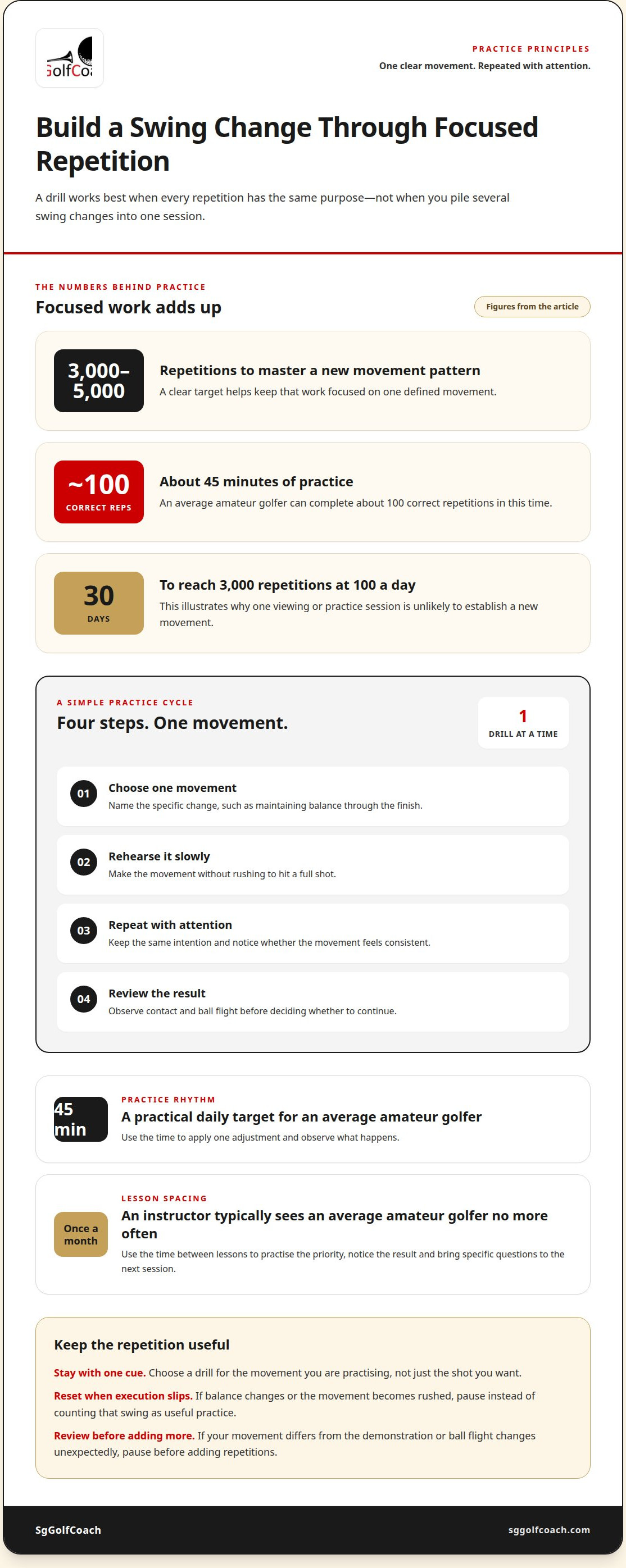
Mastering a new movement pattern can require 3,000 to 5,000 repetitions. That scale makes a clear practice target useful: work on one defined movement rather than changing several parts of your swing during the same session. For example, if your lesson focuses on keeping your balance through the finish, make that the purpose of each repetition.
An average amateur golfer can complete about 100 correct repetitions during 45 minutes of practice. At that pace, reaching 3,000 repetitions at 100 per day takes 30 days. These figures illustrate why a single viewing or practice session is unlikely to establish a new movement. Regular, attentive repetitions give you time to notice whether the intended change is becoming more familiar.
Use a simple cycle to keep each drill purposeful:
Choose one movement. Name the specific change, such as maintaining balance through the finish.
Rehearse it slowly. Make the movement without rushing to hit a full shot.
Repeat with attention. Keep the same intention and notice whether the movement feels consistent.
Review the result. Observe the contact and ball flight before deciding whether to continue.
Choose a YouTube drill for the movement you’re practising, not just the shot you want. If a video demonstrates a balance drill, for example, focus on its balance cue rather than adding separate advice about grip or swing path. Mixing cues makes it harder to know what each repetition is teaching.
Count only repetitions that preserve the drill’s purpose. If your balance changes or the movement becomes rushed, pause and reset instead of treating every swing as useful practice. The estimate of 100 correct repetitions in 45 minutes is a guide to focused work, not a reason to keep going when your execution has slipped.
Use videos to understand a drill’s sequence, then centre your practice on one cue. If your movement differs from the demonstration or the ball flight changes unexpectedly, pause before adding repetitions. A coach can help identify a suitable drill and refine its purpose, so you practise a clear movement rather than guess.
Practice frequency and lesson spacing
A useful rhythm separates instruction from independent practice. For an average amateur golfer, a practical target is 45 minutes of practice a day. Lessons can be spaced farther apart, giving you time to apply one adjustment, observe its effect and bring specific questions to your next session.
One instructor typically sees an average amateur golfer no more than once a month. That interval is not a reason to leave practice until the next lesson. Instead, treat each session as a point of direction: clarify the swing priority, practise it between visits and note what happens. For example, if the focus is a more balanced finish, use practice time to work on that feeling rather than collecting unrelated tips.
Professional golfers working with the instructor are not seen more often than every 10 days, except when they are working on different skills. The comparison shows that frequent lessons are not the only route to structured development. The time between coaching sessions matters because it gives players space to practise, notice patterns and return with useful observations.
A 45-minute daily practice target can be adapted around work, family and other commitments. Keep the session focused rather than trying to cover every club and swing thought. One example is to begin with the movement discussed in your lesson, then hit shots while keeping that same intention. If your attention shifts to a new video tip, return to the original cue before changing your plan.
Use the following sequence to make the gap between lessons productive:
Recall the priority. Write down the main adjustment from your lesson in plain language.
Practise that adjustment. Use your 45-minute practice period to apply it consistently.
Notice the result. Record an example of what felt clearer and where the movement broke down.
Bring focused questions. Use your next monthly lesson to review those observations and set the next priority.
YouTube can support this routine when a video revisits a concept covered in coaching. Replaying a demonstration of the same setup cue, for example, can help you recall its sequence before practice. Avoid replacing that cue with conflicting advice halfway through, since changing direction makes progress harder to assess.
For adults who want a coach to set a clear practice priority and review their progress, SgGolfCoach’s Adult Lessons provide a structured point of reference. Each lesson can guide focused practice beyond the session, helping connect one meeting to the next.
Using YouTube to reinforce lessons
YouTube works best between lessons when a video revisits a concept your coach has introduced. Replaying a demonstration of your setup, for example, can help you recall the sequence before practising. Videos can reinforce taught concepts, explain the theory behind a drill and help maintain motivation. They supplement structured coaching rather than replace it.
Keep each video connected to one lesson priority. If you’re working on balance, choose a clip that explains balance rather than switching to advice about grip or swing speed. A specific focus helps you understand the idea without turning practice into a search for multiple fixes.
Try this simple routine between sessions:
Recall the lesson cue. Write down one idea, such as keeping your finish balanced.
Choose a related video. Find an explanation that develops that same cue, not a different swing change.
Watch for the principle. Notice how the demonstration explains balance, rather than trying to copy every detail.
Practise with one intention. Use the lesson cue and observe whether it remains clear through your swings.
Return to the cue. If another video introduces conflicting advice, set it aside until you can discuss it with your coach.
A video can also explain why a lesson cue matters. Your coach might ask you to maintain balance through the finish, for instance. A relevant demonstration can connect that movement to the wider swing sequence. Use the explanation to understand the purpose, then keep your practice anchored to the adjustment you’ve been taught.
Choose clips that teach the same skill from a compatible angle. A demonstration of setup fundamentals may reinforce a lesson about posture, while a general video about driving distance could introduce unrelated changes. The key question is not whether the video looks polished, but whether it supports your current lesson priority.
Make a brief note after each practice. Record the video’s main concept, the lesson cue it supports and one example of what felt different. This gives your next coaching conversation a clear starting point. If the clip leaves you with competing instructions, note the conflict instead of combining them in one swing.
Motivation matters between sessions, too. A short video revisiting a familiar concept can make your next practice feel purposeful, especially when progress is gradual. Treat that encouragement as support for your plan, not a reason to add another technique. YouTube is most useful as reinforcement: one lesson idea, one relevant explanation and focused practice.
How can beginners choose reliable golf instruction videos on YouTube?
Choose a video for how clearly it teaches one specific skill, not for its views or confident presentation. A beginner seeking help with grip, for example, needs an explanation of hand placement and club control, not a broad promise to transform the whole swing. A focused lesson is easier to assess and practise.
Before following a tutorial, look for practical signs of clear instruction. The instructor should identify the skill, demonstrate the movement and explain what to notice. A setup video, for example, might show how the golfer stands to the ball and name the intended position. Without an explanation of why the movement matters, it can be harder to apply the advice thoughtfully.
Check the topic. Does the video address one clear skill, such as grip or stance?
Look for a demonstration. Can you see the movement, rather than hearing instructions alone?
Listen for a purpose. Does the instructor explain what the movement is meant to change?
Assess the level. Does the explanation suit a beginner, or rely on terms it never explains?
Keep the advice consistent. Does it fit the skill you’re currently practising?
Use a video’s specificity as a guide. A tutorial that says “fix your swing” covers too much for a first practice. One focused on a defined issue, such as establishing a balanced stance, gives you a clearer learning target. That does not prove the advice suits your swing, so treat it as an idea to understand, not an automatic correction.
Be cautious of advice that asks you to change several movements at once. If a clip discusses grip, posture and swing path in one pass, a beginner may struggle to tell which change affects the shot. Prefer explanations that separate the ideas and demonstrate the movement being taught. Avoid combining contradictory instructions from two tutorials in the same practice.
Before practising, name the video’s skill, state its main cue and decide what you’ll observe. If you can’t do that, the clip may be too broad or unclear for your immediate goal. If a coach has given you a specific cue, choose a video that explains that concept rather than introducing another swing change.
For guidance matched to your own swing, get support with your golf practice rather than relying on video demonstrations alone.
Credentials can provide context, but they don’t by themselves show whether a particular lesson is clear, accurate or suitable for a beginner. The instructor says he has been teaching golf since 1995. The page states that the instructor played professional golf for 8 years and has worked with more than 100 playing professionals. Those details describe background and price, not a guarantee that every video fits your needs. Golf instruction videos are a supplement rather than a substitute for structured coaching. If a video leaves you uncertain about a cue or how it applies, continue with one simple practice focus and seek structured guidance for individualized feedback.
SgGolfCoach: Adult Lessons
SgGolfCoach offers Adult Lessons for golfers who want personalised guidance beyond general online tips. If YouTube leaves you unsure which swing adjustment suits your game, coaching can focus your practice on technique and course management. Lessons are tailored to adults, connecting instruction with the skills you work on independently.
You can also book indoor screen golf with SgGolfCoach for practice. Choose Adult Lessons when you want coaching, or screen golf when you want an indoor setting to practise. Videos can still support your learning by revisiting ideas covered in coaching.
Contact SgGolfCoach to discuss Adult Lessons and your golf-learning goals.
Choose a practice path you can sustain
Your next step need not be a dramatic swing overhaul. Choose one skill you want to understand better, then decide whether a video can clarify it or personal feedback would help you apply it. The aim is a focused, enjoyable learning routine, not an endless collection of tips.
The choice between learning golf on YouTube and taking lessons can change as your game develops. Use videos to explore and revisit concepts, and turn to coaching for guidance shaped around your movement. That way, each practice session becomes a purposeful step instead of another attempt to try everything at once.
If you’re ready to make your next step more personal, contact SgGolfCoach about golf lessons. Bring the skill you’d like to work on, and start building confidence through focused practice.
Frequently Asked Questions
How effective is learning golf from YouTube compared with in-person lessons?
YouTube can help you understand golf terminology and see a skill demonstrated, while a lesson gives you feedback on your own movement. A video can show what a pitch shot involves, for example, but a coach can observe your contact and help refine the motion. Use videos to prepare for or revisit an idea; choose lessons when you need individual guidance to apply it to your game.



Comments