

Ways to keep improving after passing a proficiency test

Passing a proficiency test is a milestone, not the finish line. If you’re deciding what to do after passing a proficiency test, use it as a checkpoint: identify which golf skills feel less consistent, then build regular practice around them.
Recognise the progress you’ve made, while noting the areas you’d like to strengthen, such as swing technique, decision-making or confidence in different situations. Passing doesn’t mean every part of your game feels equally reliable.
This guide shows how to pinpoint skills to work on, turn them into practical practice goals and fit steady sessions into your routine. Tailored coaching and screen-golf practice can also support continued progress, helping you make your next steps focused and achievable.
Table of Contents
1. Focusing on weaker skills
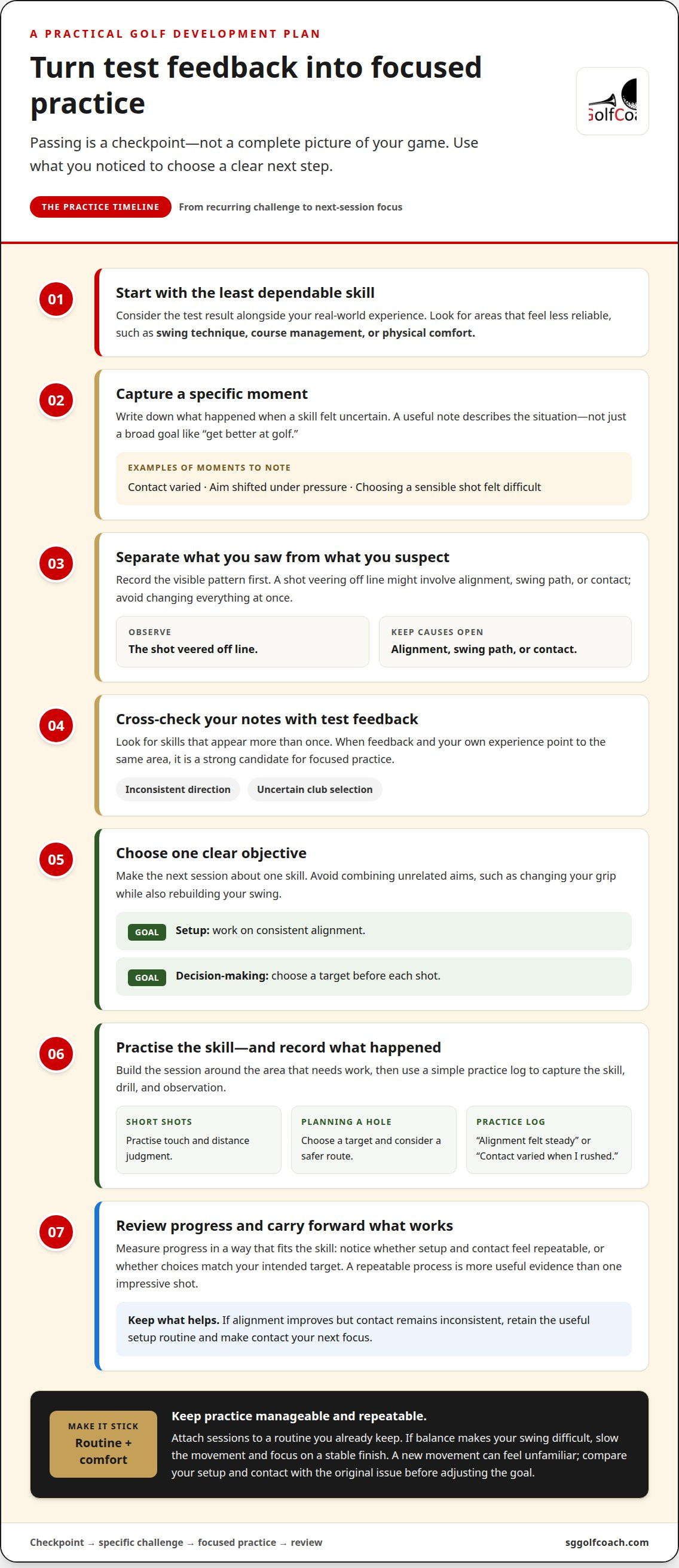
Passing a proficiency test marks a useful checkpoint, not a complete picture of your golf game. A test samples particular skills under specific conditions. To decide what to do after passing a proficiency test, consider the result alongside your experience and identify where practice could help most, such as swing technique, course management or physical comfort.
Start with the moments that felt least dependable during the assessment. Perhaps your contact varied, your aim shifted under pressure or you struggled to choose a sensible shot. Write down the situation and what happened. A specific example makes a more useful practice target than “get better at golf.”
Separate what you observed from what you think caused it. A shot that veers off line might involve alignment, swing path or contact. Rather than changing everything at once, note the visible pattern first. This keeps your next practice session focused on a skill you can work on.
Review any test feedback alongside your own observations. Note skills that came up more than once, such as inconsistent direction or uncertain club selection. When feedback and experience point to the same area, it’s a strong candidate for focused practice.
Choose a clear objective for your next session. For example, work on setting up with consistent alignment or practise choosing a target before each shot. Avoid combining unrelated aims, such as changing your grip while also rebuilding your swing. A defined goal makes it easier to notice changes.
Build practice around the skill that needs work, not just the most enjoyable part of your game. If short shots feel less controlled, practise touch and distance judgment. If you lack confidence when planning a hole, rehearse choosing a target and considering a safer route.
Use a simple practice log to record the skill, drill and your observation. Write “alignment felt steady” or “contact varied when I rushed,” rather than “good session.” Specific notes can reveal recurring challenges and help shape your next goal.
Measure progress in a way that fits the skill. For swing technique, notice whether your setup and contact feel repeatable. For course management, consider whether your choices match your intended target. One impressive shot can be encouraging, but a repeatable process is more useful evidence.
When a change feels awkward, don’t treat that discomfort as proof it has failed. A new movement can feel unfamiliar before it becomes more natural. Compare your setup and ball contact with the original issue, then adjust your practice goal if the same problem persists.
Pay attention to physical comfort as you practise. If maintaining balance makes your swing difficult, slow the movement and focus on a stable finish. Golf also offers fitness benefits, but practice should suit your comfort and current ability.
Make sessions manageable by attaching them to a routine you already keep. For example, practise after a regular workday activity or reserve a familiar slot in your weekly schedule. A repeatable cue makes practice easier to remember than waiting for a free afternoon.
For younger players, adults can help turn test feedback into a positive learning plan. A junior who rushes their setup can practise pausing before a shot, while an adult who feels unsure about targets can focus on making a deliberate choice. Keep the goal specific and encouraging.
Review your notes after practice and decide what to keep. If alignment improves but contact remains inconsistent, retain the useful setup routine and make contact your next focus. This builds on progress instead of replacing one unfinished change with another.
If you’re still considering what to do after passing a proficiency test, make the next step manageable: identify a recurring challenge, choose a focused practice goal and observe what happens. This turns the result into direction for continued learning, rather than a reason to stop developing your game.
Discomfort with a new approach doesn’t by itself mean the practice is unhelpful. Return to a manageable goal and observe whether your process becomes more consistent. English proficiency tests assess speaking, writing, listening and reading across academic, professional and casual contexts. This is a reminder to judge progress against the particular skill you’re practising, rather than relying on a general impression.
4. Are there fees or deadlines after passing a proficiency test in Singapore?
Passing a proficiency test in Singapore doesn’t create one universal fee or deadline. The next step depends on the test’s purpose and the organisation using its result. An IPPT, an English assessment and an admissions test belong to different processes. Use the result for its intended purpose, then follow the next steps for that process.
Passing a test doesn’t establish a universal post-test charge. Costs depend on what the next step involves, such as an application or further assessment. Keep test-related payments separate from later administrative steps. For example, an IPPT result has enlistment timing rules, while an English test may support an education application.
For eligible Singapore pre-enlistees, the key timing rule concerns qualifying for direct basic training. The qualifying IPPT result must be attained at least two weeks before PTP enlistment. A result achieved closer to enlistment doesn’t meet that timing condition for this route. Plan around the enlistment date, not just the test date.
The IPPT result remains valid for one year after the test. This matters when you’re planning around an enlistment date or a later administrative step. Record both dates, then check whether the result falls within its one-year validity period when it’s needed.
Pre-enlistees may attempt the IPPT as many times as they like before the applicable deadline. For an eligible pre-enlistee, the final attempt must still meet the relevant timing rule. To qualify for direct basic training through PTP, the passing result must meet the two-week condition. Previous attempts don’t remove the need to track that deadline.
The timing of the pre-enlistee IPPT also depends on enlistment date. Those enlisting before October 2027 may take it if medically graded PES A or B1. Eligible pre-enlistees enlisting from October 2027 onwards will be informed through OneNS to book their IPPT. These details help distinguish booking steps from result deadlines.
There is also a final-attempt cutoff: a pre-enlistee may attempt the test up to the last Wednesday at least 14 calendar days before enlistment. This date and the two-week qualifying condition both matter. Schedule attempts with enough time for a qualifying result, instead of leaving the decision until the enlistment date is close.
These rules apply to the pre-enlistee IPPT, not automatically to every proficiency test in Singapore. An English assessment, school test or workplace requirement has its own next step. The receiving organisation determines how it uses the result and whether a further application or assessment is required.
For education applications, distinguish the test result from the application process. The result may be one part of an institution’s requirements, while submission steps and any associated costs relate to the application itself. Record the test name, result date, receiving institution and next required action to keep the processes separate.
In practical terms, what to do after passing a proficiency test depends first on which test you took. For IPPT, note the result date, its one-year validity and the enlistment deadline. For another assessment, find out how the receiving organisation uses the result and which application step follows.
Keep a short record of the test name, result date, deadline and any payment connected to the next step. This helps distinguish an assessment fee from an application cost and prevents an IPPT timing rule from being mistaken for an education or employment requirement.
For anyone asking what to do after passing a proficiency test, the useful next move is to match the result to its intended process. An IPPT pass relates to enlistment conditions; a golf proficiency result points toward continued skill development. Keeping these purposes separate makes the next decision clearer.
In short, Singapore has no single post-pass fee or deadline for every proficiency test. For eligible pre-enlistees, the qualifying IPPT result must be attained at least two weeks before PTP enlistment and remains valid for one year after the test. Other assessments follow the steps and costs of their own application processes.
assessment may follow a separate process. In Singapore’s Ministry of Education PGDE selection process, an Entrance Proficiency Test invitation is not selection for appointment. After interview, applicants can expect to hear about their application within 4 - 5 weeks.
SgGolfCoach
SgGolfCoach can help you turn a golf proficiency result into a focused plan for continued development. If the test highlighted areas to strengthen, Junior Programs and Adult Lessons offer coaching suited to the learner’s stage. Screen Golf Booking provides an indoor setting for continued practice, while PC & Handicap supports players working on their golf profile.
Consider coaching when you want help turning test feedback into practical goals, or when your progress feels less consistent than you’d like. Choose the kind of support that fits your priorities, then continue building your skills through purposeful practice.
Contact SgGolfCoach to discuss your next step.
Keep building your game
Your next goal doesn’t need to be dramatic. Choose a skill you’d like to make more dependable, then give it a place in your regular golf routine. That turns a pass into a starting point for continued learning, with progress shaped by deliberate practice rather than a single result. If you’re deciding what to do after passing a proficiency test, focus on the kind of golfer you want to become and the next step that suits you now.
SgGolfCoach supports that ongoing journey through Junior Programs, Adult Lessons and Screen Golf Booking. Each offers a different way to keep learning, whether you’re supporting a young player, developing your own game or looking for an indoor practice setting.
Contact SgGolfCoach for advice and take your next step with confidence.



Comments